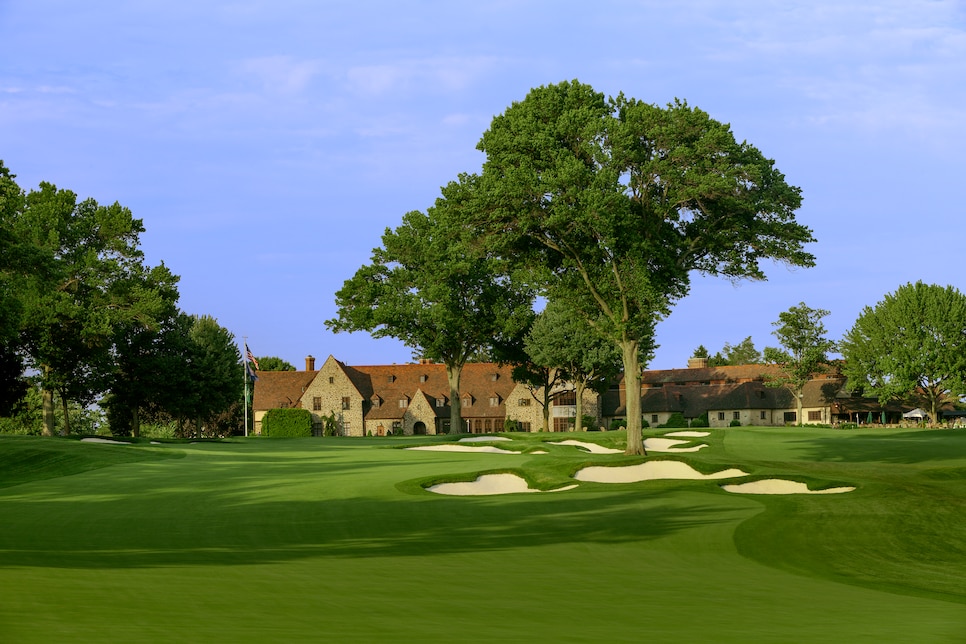
Another extended major championship edition of the Caddie GI Weekly Primer. It’s a home game right in our backyard, and we’ve got you covered with everything you need to know. Pumped for this one.
The PGA Championship returns to Aronimink Golf Club for the first time since 1962, when Gary Player lifted the Wanamaker Trophy on a Donald Ross masterpiece that most of the modern golf world has never seen in major-championship form. Scheffler defends. McIlroy arrives chasing the calendar Grand Slam. Fitzpatrick has three wins in 2026, Young has two, and both are playing some of the best golf of their respective careers. Oh, and Spieth only needs the Wanamaker to complete the career Grand Slam. One hundred and fifty-six players, a 36-hole cut, and a par 70 gem that Gil Hanse spent three years restoring to the way Ross originally built it.
Aronimink sits in Newtown Square, about 15 miles west of Center City Philadelphia on the Main Line. The 2026 PGA Championship coincides with the United States Semiquincentennial — the 250th anniversary of the nation’s founding in the city just down the road. Expected attendance is north of 200,000 across championship week. It’s a big year for Philly — a major championship in May, and World Cup in June with a possible side of Sixers or Flyers finals series (one can dream).
| Day | TV Coverage (ET) |
|---|---|
| Thu 5/14 | ESPN 12–7 PM · ESPN2 7–8 PM |
| Fri 5/15 | ESPN 12–8 PM |
| Sat 5/16 | ESPN 10 AM–1 PM · CBS 1–7 PM |
| Sun 5/17 | ESPN 10 AM–1 PM · CBS 1–7 PM |
Streaming: ESPN+ (all day, featured groups + featured holes). CBS simulcast on Paramount+. Early coverage from 6:45 AM Thu/Fri, 8 AM Sat/Sun on ESPN+.
Aronimink traces its roots to the 1896 Belmont Golf Association in southwest Philadelphia. The club’s early caddie yard produced two of Philadelphia golf’s founding figures. Hugh Wilson won Aronimink’s first club championship at 18 and later designed Merion’s East Course. Johnny McDermott learned the game hitting iron shots to tin cans in an apple orchard along the 7th fairway before becoming the first American-born U.S. Open champion at 19.
After two intermediate moves, the club purchased 300 acres in Newtown Square in 1925 and engaged Donald Ross — at the height of his career — to build the course that opened on Memorial Day 1928. Returning two decades later, Ross delivered the line that has followed the property ever since:
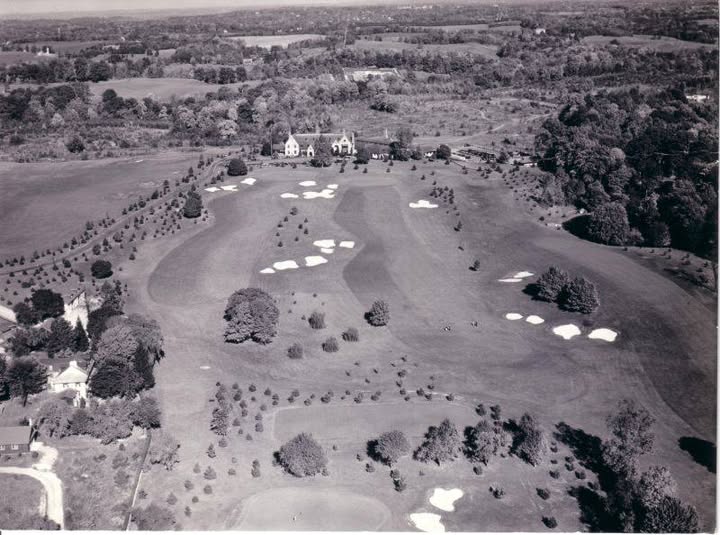
Aronimink from the air, October 1939 — the 18th (left), 9th (middle), and 10th (right) holes with the clubhouse at center. Note the sparse tree cover compared to the modern course. J. Victor Dallin Aerial Survey Collection, Hagley Museum and Library.
The course’s architectural lineage after Ross is layered and star-studded. William Gordon in the 1950s, Dick Wilson in 1961, George and Tom Fazio in 1978, and Robert Trent Jones Sr. in 1989 all touched the layout, generally simplifying the original bunkering. Restoration began in the 1990s under Ross specialist Ron Prichard, who worked from Ross’s drawings. The most recent intervention came in 2015–2017, when Gil Hanse and Jim Wagner — both Philadelphia residents — were hired for a roughly $4 million restoration.
Hanse worked from 1929 aerial photographs rather than Ross’s plans, because the photos revealed that what was actually built differed from the drawings. The course originally featured more than 190 bunkers in dense clusters of three and four — a signature widely attributed to associate J.B. McGovern, working on site in Ross’s absence. Hanse re-installed roughly 100 additional bunkers, expanded greens to recover lost hole locations, widened fairways, and removed trees. Aronimink has all 18 of its original Donald Ross greens — a rarity for a century-old course. The course now features 176 bunkers, more than almost any venue on the PGA Tour schedule.
The 1962 PGA Championship carries its own historical weight. It was originally awarded to Brentwood Country Club in Los Angeles, but California Attorney General Stanley Mosk threatened the PGA’s ability to operate in the state over its “Caucasian-only” clause. The PGA pulled the championship and re-sited it at Aronimink, then formally dropped the clause in November 1961. Aronimink 1962 hosted the PGA’s first championship of the modern, integrated era. Gary Player won and still has a locker in the clubhouse. The club’s connection to golf’s racial history runs even deeper — Aronimink’s first professional was John Shippen, one of the first Black golfers to compete in a U.S. Open, whose 1896 entry at Shinnecock Hills nearly caused a boycott before the USGA refused to back down.
Andy Johnson of The Fried Egg described Aronimink’s site as “the sink” — the property forms a gentle bowl, and Ross routes shots into it (downhill), out of it (uphill), and across its sloping sides. See his walkthrough →
The low point of the property sits at the pond short of the 8th green, and the holes that work into and out of that basin — 8, 9, 10, 18 — produce some of the most dramatic elevation changes. The outer holes (1 through 7, 11 through 16) sit on a gently sloping plateau with more modest terrain.
Ross’s greens at Aronimink generally tilt back-to-front as they do at many of his courses. The distinctive spines, shoulders, and ridges that run from the perimeter into the center of the surfaces, creating distinct quadrants and can be punishing. Approaches that land on the wrong side of a ridge will produce the kind of scattered short-game disasters that are common at Ross venues. The greens are bentgrass, expected to run at major-championship speeds — likely 12.5+ on the Stimpmeter, up from the customary 10.5–12 for member play. My three putts would turn into four putts.
The championship setup plays as par 70 at approximately 7,400 yards, converting two par 5s to long par 4s. Off the tee, accuracy matters more than raw distance given the cluster-bunker corridors at landing zones — especially on 6, 11, and 16. Hitting the right spots off the tee will set you up for intentional approach shots into preferred quadrants. The difference between putting for birdie and scrambling for par is minuscule.
Where the Wanamaker will be won, and a few shots from over the years.
Aronimink’s layout works in your favor. Ross may have had the spectator in mind just as much as the player. The property sits in a natural bowl, and the best spectator positions cluster in two zones: the bottom of the bowl and the clubhouse ridge. You can see a lot of golf without walking far.
The bowl. Plant yourself anywhere along the 9th, 10th, or 18th fairways and you’re in the guts of the course. These holes give you a feel for the elevation changes on the property, and you get sightlines to multiple greens and tees without chasing groups. The area between the 9th green and 18th green, directly in front of the clubhouse, is the single best place to stand if you want to watch finishes unfold on Sunday — you can see both greens from one spot.
The par 3s. The 8th and 17th greens are worth staking out, especially in the afternoon. Both 225+ with water short, you can expect to see some carnage. The crowd energy on par 3’s at major championships is also different from anything else in golf. The 8th green is the other must-see par 3 and one of the iconic holes at the Mink. It played as the hardest hole at the 2018 BMW, and the reactions when a player stiffs a 230-yard iron to a back pin will be worth the walk.
The hidden vantage. The 7th green perch gives you a look at the 11th green across the way — the Hanse favorite with roughly 20 bunkers in diagonal clusters. Two of the most architecturally dramatic greens on the course, visible from one position. You’ll also have a decent view of the 12th tee and be a short walk from the par 3 8th tee. This is my top pick for viewing spots.
Walking strategy. If you want to get your steps in, I’d recommend walking holes 1 through 7 and then 11 through 16. Those stretches largely run along the outer edges of the property where the terrain is highest but flatter than the bowl itself. The inner holes (especially 8, 9, 10, and 18) work their way into and out of the bowl, and the elevation changes work in the gallery’s favor.
Rory McIlroy and the calendar Grand Slam. Back-to-back green jackets, two PGA Championship wins (Kiawah 2012, Valhalla 2014), and now the only player in the field who could complete the calendar Grand Slam — something no player has done since Bobby Jones in 1930. He finished T47 at last year’s PGA at Quail Hollow — a quiet reminder that this championship has not been kind to him recently.
Scottie Scheffler defends. Won at Quail Hollow last May by five. Three consecutive runner-up finishes since — beaten by McIlroy at Augusta, Fitzpatrick at the Heritage, and Young at Doral. The tee-to-green numbers remain elite, but the putter has been inconsistent. Scheffler is hitting it as well as anyone in the world but needs the flatstick to cooperate for 72 holes.
Cameron Young is the player of the spring. His dominant win at Doral by six over Scheffler, The Players in March, a T3 at the Masters — two wins in 14 starts and a career-high No. 3 in the world. He switched to a Titleist Pro V1x Double Dot prototype ball late last season and has said it “makes golf easier for me.” I will also be switching to the Titleist Pro V1x Double Dot prototype ball this week.
Keegan Bradley returns to the scene. Bradley won the 2018 BMW at Aronimink with four rounds in the 60s (66-64-66-64) — his first Tour win in six years and 160 starts. He captained the 2025 U.S. Ryder Cup team at Bethpage, and the loss has lingered. He called it the darkest period of his career. A major championship at the course where he resurrected his career once before is the kind of script golf tends to write.
LIV Golf players in the field. Anxious? Regretful? Jealous? All of the above? Bryson DeChambeau, Jon Rahm, Brooks Koepka, Tyrrell Hatton, Joaquin Niemann, and Cameron Smith all qualify under the PGA Championship’s criteria. For some of them, these major championship weeks are starting to feel less like homecomings and more like auditions. DeChambeau and Rahm are both priced inside the top five by most books despite limited recent stroke-play data at 72-hole events.
Two weeks in. At Doral, four of the top five Par+ players finished inside the top five on the leaderboard — Young (#1) won, Scheffler (#3) finished second, Scott (#4) and Kim (#5) both finished T4. Pretty unbelievable for the first week, but probably won’t be the norm. At Quail Hollow, the winner was Kristoffer Reitan, ranked 51st by the model. Hard to see that one coming. But the top of the rankings still showed up: Åberg (#5) finished T8, Fleetwood (#12) T5, Højgaard (#13) T2, Cantlay (#11) T10, Young (#2) T10. Two tournaments, two very different outcomes, but the contenders list held up both weeks.
The field expands to 156 players this week, including LIV players who don’t have PGA Tour strokes-gained data in the system. Take their rankings as market-informed placeholders rather than full model outputs.
| # | Player | Par+ | Course Fit | Overall |
|---|---|---|---|---|
| 1 | Scottie Scheffler | +2.35 | 86.9 (#1) | 99.4 |
| 2 | Cameron Young | +2.22 | 85.8 (#3) | 97.0 |
| 3 | Rory McIlroy | +2.02 | 70.6 (#20) | 93.0 |
| 4 | Ludvig Åberg | +1.98 | 79.3 (#10) | 82.6 |
| 5 | Jon Rahm* | +1.98 | 65.6 (#30) | — |
| 6 | Matt Fitzpatrick | +1.96 | 86.5 (#2) | 96.8 |
| 7 | Xander Schauffele | +1.80 | 70.2 (#22) | 88.6 |
| 8 | Tommy Fleetwood | +1.78 | 81.6 (#5) | 82.0 |
| 9 | Collin Morikawa | +1.75 | 76.5 (#12) | 88.0 |
| 10 | Bryson DeChambeau* | +1.73 | 50.3 (#67) | — |
*LIV players — market pricing and course fit only. PGA Tour strokes-gained data unavailable.
What stands out: Scheffler and Young sit a tier above the field. Fitzpatrick owns the #2 course fit score (86.5) behind only Scheffler — his iron play has been spectacular and maps perfectly to Aronimink’s greens, and three wins in 2026 confirm the form. The model has him 6th; the books have him around 4.5%.
Åberg at #4 is the most interesting signal — his major championship bump of +0.265 SG per round is the highest in the top 10. No question the talent is there, but he’s been hard to trust on Sundays this year. DeChambeau at #10 is the ranking most likely to miss — his course fit of 50.3 (#67) reflects a power-over-precision profile on a course that rewards the opposite.
If you’re reading this, you’re invited.
The PGA Championship pool is open.
Join the Pool →Pool code: WANAMAKER
Si Wooooo. The strongest course fit case outside the top 10. Kim’s 81.2 course fit score ranks 7th in the entire field — higher than Schauffele, Morikawa, McIlroy, and Åberg. Six top-10 finishes in his last 12 starts, including a T4 at Doral in the final group alongside Young and Scheffler. His precision iron game and scrambling profile are almost purpose-built for a Ross course. The books have him at 1.65% but the model sees value.
Who doesn’t love Rickie? Just finished T2 at Quail Hollow. The form is trending in the right direction at the right time. Course fit of 74.0 ranks 14th in the field, and he carries the shotmaking creativity that Ross greens reward. Fowler finished T8 (−16) at the 2018 BMW at Aronimink and knows the property. At 1.8% implied odds heading into the week, the market may be ignoring recent form.
Always seems to be in the mix, rarely lifts the trophy. He’s the quietest name in the top 20. Course fit of 80.8 ranks 8th in the field. Henley is an elite iron player who rarely makes mistakes — exactly the profile that thrives at Aronimink. Currently 8th in the world rankings with the kind of consistency that doesn’t generate headlines but absolutely generates top-10 finishes. If he made a few more 6–8 footers on Sunday at Augusta, this would be a different discussion.
This is a narrative pick, not a data pick. Spieth needs only the Wanamaker to complete the career Grand Slam, and the form has been quietly trending in the right direction. Ross greens reward the kind of creative green-reading and touch putting that defined Spieth’s best years. The model doesn’t love his current numbers. But majors have a way of finding players with unfinished business, and nine years of chasing the same trophy is the kind of motivation that could get him going.
The most relevant recent reference for how Aronimink will play, with one large caveat: the course was soft. Sunday was washed out by torrential rain, the final round was played Monday under drizzle, and the winning scores reached 20-under. In a major setup with drier conditions and firmer greens, expect compression.
| Pos | Player | Score | Note |
|---|---|---|---|
| 1 | Keegan Bradley | −20 (260) | Won in playoff |
| 2 | Justin Rose | −20 (260) | Reached World No. 1 |
| T3 | Billy Horschel | −19 | |
| T3 | Xander Schauffele | −19 | |
| 5 | Rory McIlroy | −18 | 62 in Round 1 |
| T6 | Tiger Woods | −17 | 62 in Round 1, closing 65 |
| T8 | Tommy Fleetwood | −16 | 62-62 in Rounds 2–3 |
| Year | Winner | Score | Venue |
|---|---|---|---|
| 2025 | Scottie Scheffler | −11, by 5 | Quail Hollow |
| 2024 | Xander Schauffele | −21, by 1 | Valhalla |
| 2023 | Brooks Koepka | −9, by 2 | Oak Hill |
| 2022 | Justin Thomas | −5, playoff | Southern Hills |
| 2021 | Phil Mickelson | −6, by 2 | Kiawah Island |
| 2020 | Collin Morikawa | −13, by 2 | TPC Harding Park |
| 2019 | Brooks Koepka | −8, by 2 | Bethpage Black |
| 1962 | Gary Player | −2, by 1 | Aronimink |
Across the last decade of PGA Championships, eight of ten winners were elite ball-strikers in their primes. Average winning score: roughly −10 to par. SG: Approach was the dominant skill correlation in every edition from 2020 to 2025, with putting as the secondary differentiator on Sunday. Aronimink’s crowned, contoured greens fit that template almost perfectly. Caddies will have their work cut out for them.
The specific challenge at a Ross course is that the punishment for a marginal approach is disproportionate. A shot that lands eight feet from the right spot doesn’t leave eight feet more work — it can leave a 30-foot putt with two feet of break, or a chip to a green running away from you. The strokes-gained data from the 2018 BMW confirms this: the correlation between approach proximity and finishing position was stronger at Aronimink than the Tour average for the season.
What this means for pool picks and viewing: watch the approach stats on Thursday and Friday. The players who are hitting greens in the right quadrants — not just hitting greens — will separate by the weekend. The cut line will claim players who are landing on the wrong sides of Ross’s ridges and spending the week scrambling.
Given it’s a major championship, officials will go deep in their bag with thicker rough and faster greens to try to keep the winning score in the low-to-mid teens. Wednesday’s forecasted rain could soften the course heading into Thursday, which would blunt some of that defense — soft fairways hold tee shots, receptive greens accept long irons, and the crowned putting surfaces lose their teeth. A dry weekend would restore the bite. Two very different tournaments are possible depending on how much water the course takes early in the week.
| Day | High | Low | Rain % | Wind | Conditions |
|---|---|---|---|---|---|
| Thu 5/14 | 62°F | 48°F | 55% | W 10–15 | Showers likely, cool |
| Fri 5/15 | 66°F | 52°F | 45% | W 10–15 | Lingering showers, mild |
| Sat 5/16 | 72°F | 55°F | 15% | SW 8–12 | Mostly dry, warming |
| Sun 5/17 | 75°F | 58°F | 10% | SW 5–10 | Sunny, warm |
Head pro Jeff Kiddie wants the course fast and firm, but Wednesday’s rain could soften fairways and make greens receptive early. If that happens, expect lower scoring Thursday and Friday — players who post numbers on a soft course build a cushion before conditions tighten for the weekend.
The split matters: a wet-to-dry week favors aggressive early-round play and rewards the players who can adjust to firming conditions on Saturday and Sunday. If the rain stays light and drains quickly, Aronimink’s crowned greens will be running away from approaches by the weekend, and the winning score compresses toward single digits under par.
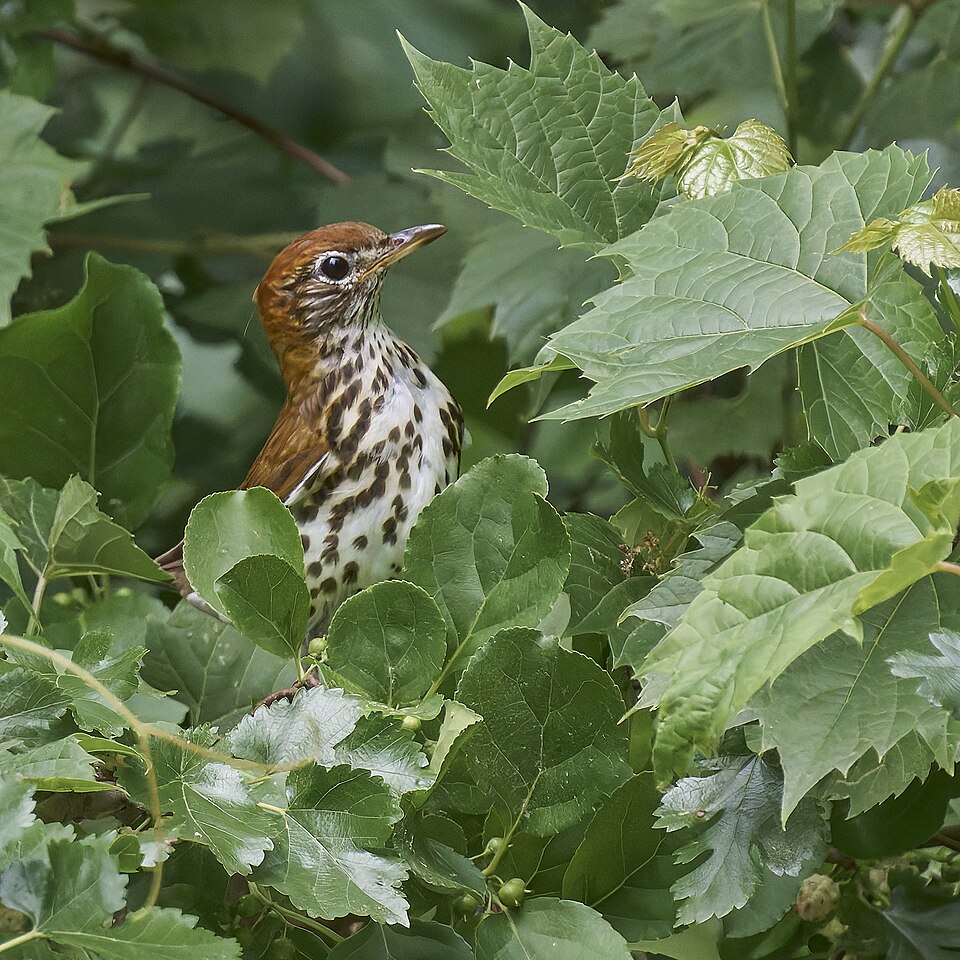
Each week, a bird native to the tournament’s corner of the country.
All food is free. Your ticket includes unlimited food and non-alcoholic beverages at every concession on the course. Burgers, chicken sandwiches, breakfast sandwiches, snacks — walk up, grab it, walk away. This is not widely advertised and most people showing up Thursday won’t know.
Alcohol is not free, and it’s not cheap. A 16oz beer is $15. Premiums are $16. A High Noon is $16.50. A non-alcoholic beer is $12. Cashless only — no cash accepted anywhere on site. Two-drink limit per transaction.
There is no on-site parking. Don’t drive to the course. SEPTA Regional Rail to Paoli Station is the best option — free shuttle from there to the main entrance, $4–$9 from Center City, about an hour door to door. If you drive, the two pre-paid lots (Delaware County Community College and Veterans Memorial) are $25 per car via SeatGeek and require a shuttle.
Cameras are banned Thursday through Sunday. Practice rounds only. No re-entry once your ticket is scanned. Kids 15 and under are free with a ticketed adult (two per adult, pick up comp tickets at Admissions). Military admission is free — register via GOVX.
If you made it this far, meet me at the 17th green for a beer around 1pm on Friday. Should be a hell of a week at the Mink.
Sources: PGA of America · PGA Championship · DataGolf · Golf Digest · The Fried Egg · LINKS Magazine · Pro Golf Weekly · KPMG Women’s PGA Championship · BMW Championship · Wikipedia · CBS Sports · Covers · Yahoo Sports · Sportsbook Review · Sky Sports · Golf Channel · AccuWeather · Cornell Lab of Ornithology · Audubon · Hagley Museum and Library (J. Victor Dallin Aerial Survey Collection) · Fred Byrod, “One of The Founding Four,” Aronimink Golf Club Archives
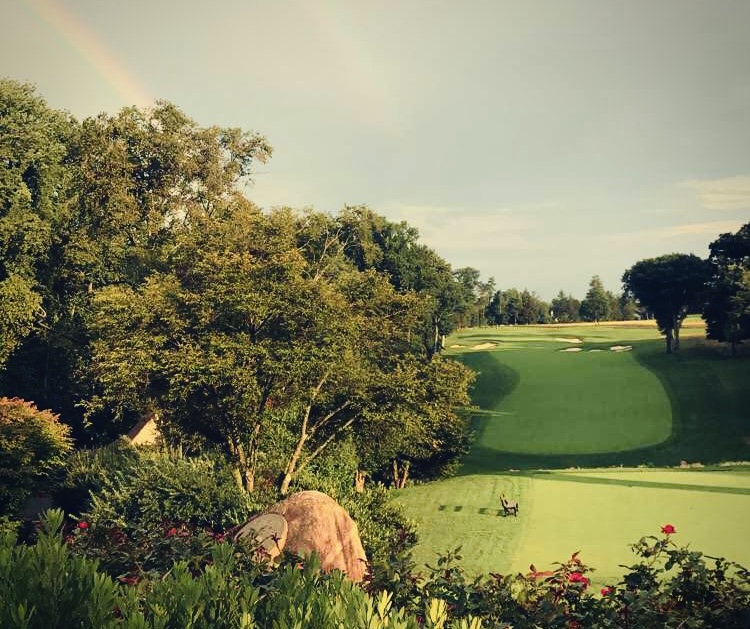 Nervy downhill tee shot from below the clubhouse, then a steeply uphill approach to a green that angles back-and-left with a strong back-to-front pitch. Four bunkers right of the fairway and two flanking the front of the green. One of golf’s most intimidating opening tee shots because of the elevation change — the ball is in the air for what feels like forever. In member play, you feel every eye from the clubhouse patio looking on with… interest.
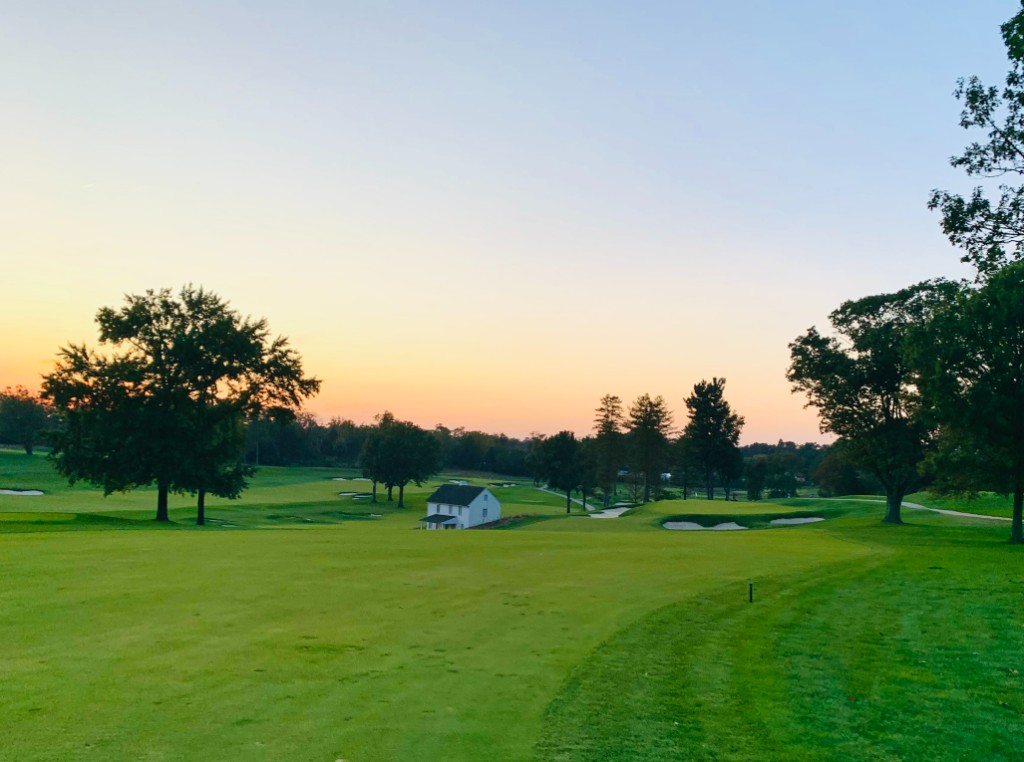 A downhill dog-leg right par 4 with one of the most fun and difficult approach shots on the course. Good tee shots often filter down the slanted fairway, leaving just a wedge in, but there’s still no easy second shot. Flat lies are hard to come by. Bunkers aggressively guard the green and good luck with par if you land in one. One of my favorites.
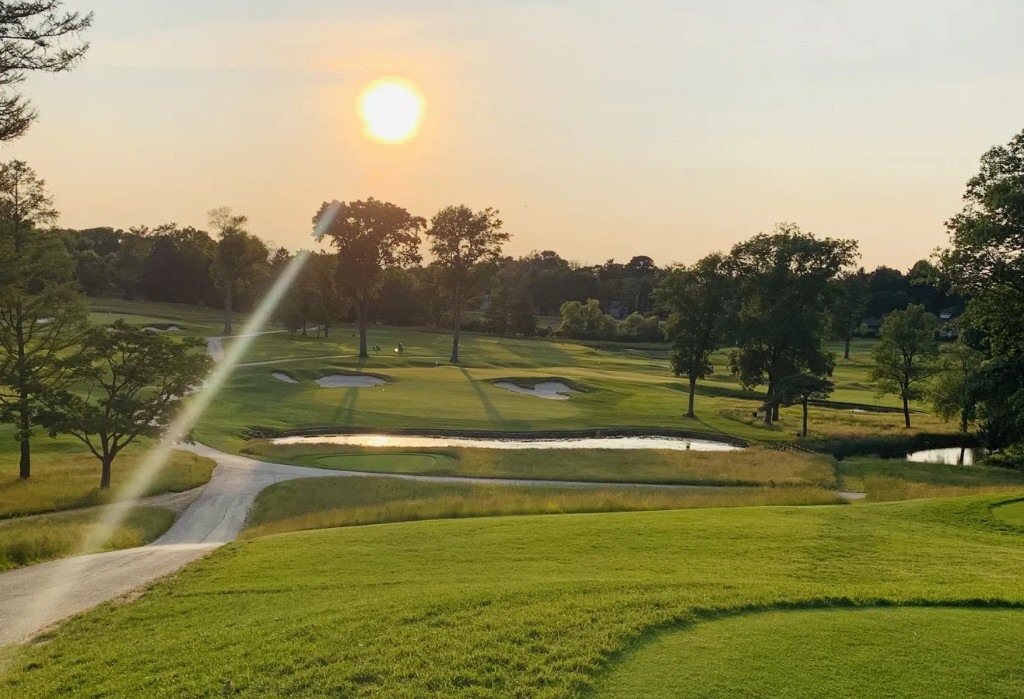 What a view, only ruined by a bogey. Played as the toughest hole on the course during the 2018 BMW Championship. A long, downhill, brute-force par 3 to a narrow target. The safe line is splitting the uprights of two tall oaks standing proudly past the green. This is not a hole to get aggressive on. Birdie here is exceptional.
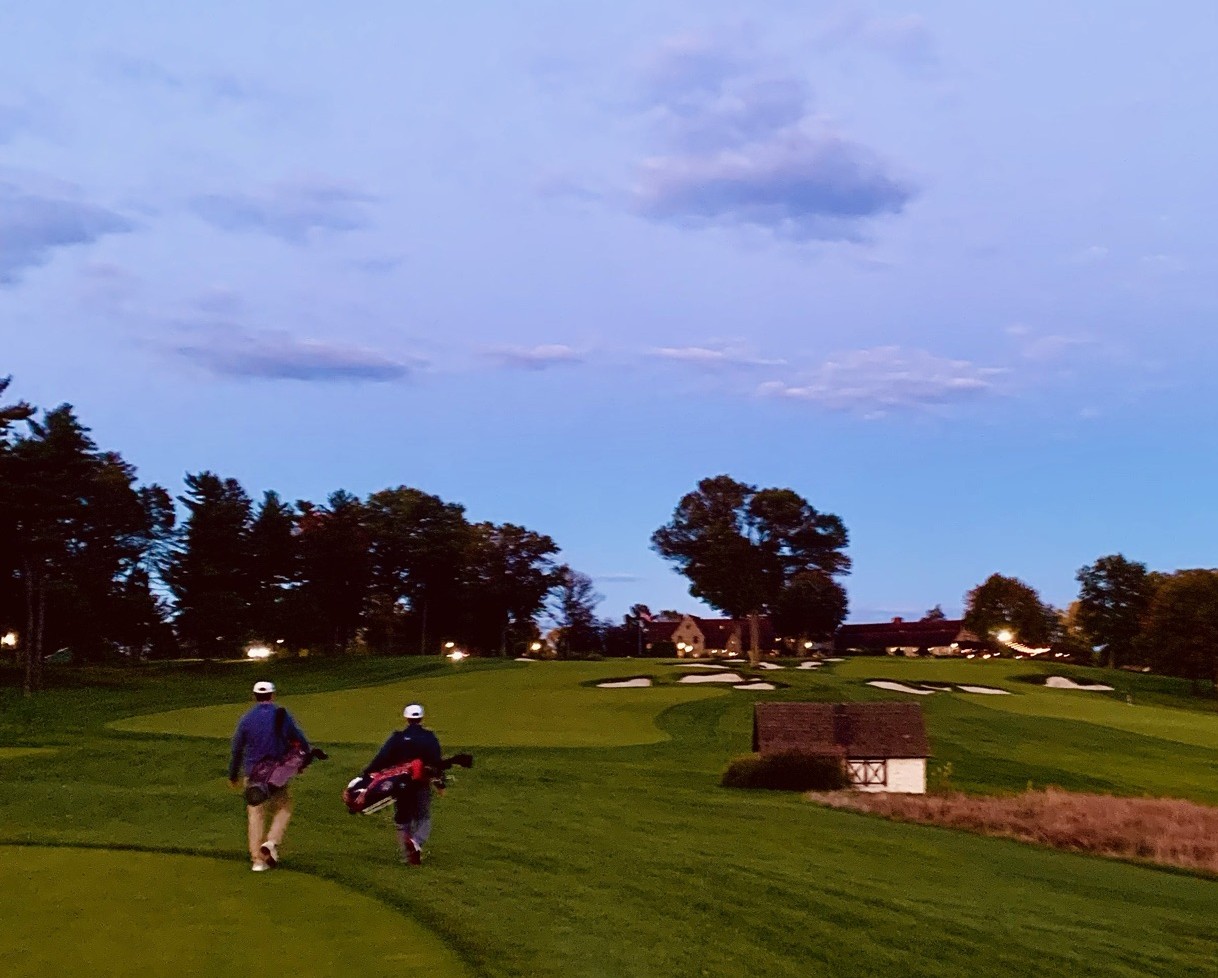 An uphill trudge, similar to the 9th. A new tee makes this the longest par 4 on the property. The famous tree-tunneled entrance lines the left, and clustered bunkers and a solitary oak team up to create trouble on the right. The approach plays to a large terraced green in front of the clubhouse — expect a front right pin position on Sunday, with a large bunker ready to swallow up anything short. In the 2018 BMW playoff, Justin Rose pulled his tee shot into trouble and made bogey; Keegan Bradley parred to win.