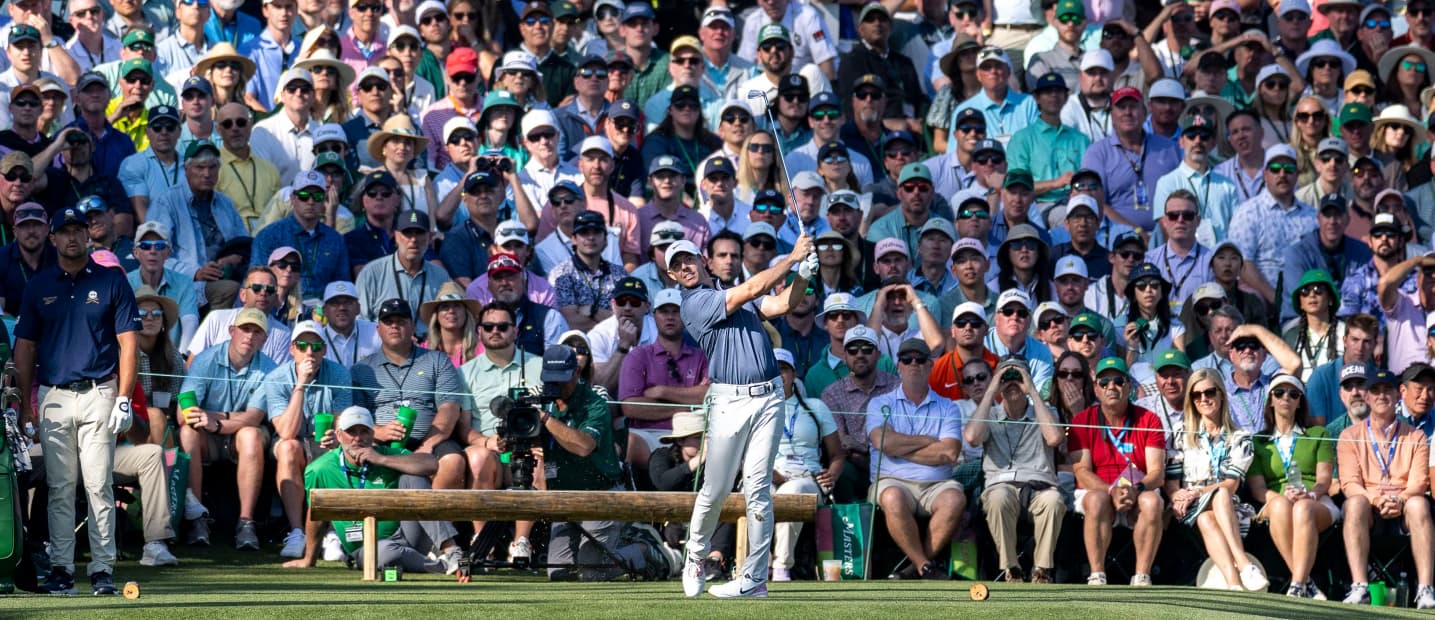
This is the extended Masters edition of the Caddie GI Weekly Primer. More history, more data, more context than our usual tournament preview — because it's The Masters. The best tradition in golf that only gets better every year.
Scheffler arrives at Augusta National as the clear favorite to become just the fifth player in history to win three green jackets, but McIlroy's title defense, DeChambeau's hot run of form, and the disappointing absence of Tiger Woods have turned the 90th Masters into one of the most storyline-rich tournaments in decades. Ninety-one players. Eighteen past champions. Twenty-two debutants. A lengthened 17th hole pushing the course to a record 7,565 yards. And DeChambeau — winner of his last two starts — arriving with arguably the hottest form of anyone in the field.
Bobby Jones and Clifford Roberts founded the Masters in 1934 on the grounds of a former commercial nursery — which is why every hole at Augusta National is named after a flowering plant or tree. The tournament was originally called the Augusta National Invitation Tournament. Jones hated the name "Masters," considering it presumptuous. Roberts won that argument.
Strict green jacket custody rules dictate that champions keep it for one year, after which it must remain in their personal locker at Augusta — it can only be worn on club grounds. Win multiple times and the same jacket gets re-fitted. No new one. The jackets were first presented to champions in 1949 (Sam Snead was the first recipient).
The Champions Dinner has been a Tuesday night tradition since Ben Hogan started it in 1952. The defending champion picks the menu and pays the bill. This year McIlroy went with a wagyu filet mignon, sticky toffee pudding, a 1990 Chateau Lafite Rothschild from the year he won, and a 1989 Chateau d'Yquem from his birth year. He called the dessert wine "liquid gold." Classy stuff. Scheffler served notoriously spicy tortilla soup in 2023 — Danny Willett asked if he was trying to kill the table.
The Par 3 Contest has been played since 1960. No winner of the Par 3 Contest has ever won the Masters the same week. Ninety-four holes-in-one have been made in its history, including nine in 2016 alone. Many top players now intentionally avoid winning it. I find the curse narrative to be a nothing burger — the chances of winning both are slim at best.
Amateurs stay in the Crow's Nest — a 30-by-40-foot room atop the clubhouse partitioned into sleeping cubicles with one bathroom and a small TV. Former Crow's Nest residents who went on to win the Masters: Nicklaus, Woods, Mickelson, Crenshaw, Watson. If you're headed to Augusta, make sure to get yourself a Crow's Nest beer. Crispy.
The Eisenhower Tree — a loblolly pine on the 17th that President Eisenhower hit so often he proposed cutting it down at a 1956 club meeting — was removed in 2014 after an ice storm. Roberts adjourned that meeting immediately rather than reject a sitting president to his face.
Three bridges honor legends: the Sarazen Bridge (15th hole, the 1935 albatross), the Hogan Bridge (12th hole, the 1953 record 274), and the Nelson Bridge (13th, a six-shot swing in two holes in 1937). Jimmy Demaret, the first three-time winner, once complained: "I won three times and I never got an outhouse."
Among the quirks you might hear Jim Nantz mention: spectators are "patrons," never fans. Cell phones are banned — violators face permanent revocation. The white sand in bunkers is granulated quartz crystal from North Carolina. Caddie bib No. 1 always goes to the defending champion's caddie. Inflation has not hit Augusta and the pimento cheese sandwich still costs $1.50.
Honorary starters Jack Nicklaus (86), Gary Player (90), and Tom Watson (76) will hit the ceremonial first tee shots on Thursday morning. Amazon Prime Video (who doesn't love more confusion with how to watch?) makes its Masters broadcast debut with Thursday and Friday coverage alongside CBS Sports and ESPN, with the legendary Nicklaus serving as a featured guest in the broadcast booth.
Augusta National produces the most statistically predictable champion profile of any major. These are the five filters that matter most, and the data beneath them is overwhelming.
Ninety-one players. The most internationally diverse field in Masters history, with a record eight Nordic players.
Past Champions (Last 10 Years)
| Year | Champion | Score | Status |
|---|---|---|---|
| 2025 | Rory McIlroy | -9 (playoff) | Defending |
| 2024 | Scottie Scheffler | -11 | World No. 1 |
| 2023 | Jon Rahm | -12 | LIV Golf |
| 2022 | Scottie Scheffler | -10 | World No. 1 |
| 2021 | Hideki Matsuyama | -10 | In field |
| 2020 | Dustin Johnson | -20 (record) | LIV Golf |
| 2019 | Tiger Woods | -13 | Not in field (WD) |
| 2018 | Patrick Reed | -15 | DP World Tour |
| 2017 | Sergio Garcia | -9 (playoff) | LIV Golf |
| 2016 | Danny Willett | -5 | In field |
Notable First-Timers (22 Debutants Total)
| Player | Qualification | Notable |
|---|---|---|
| Chris Gotterup | Multiple PGA Tour wins | 4 wins pre-debut — 3rd since WWII |
| Jacob Bridgeman | Genesis Invitational winner | Leads Tour in SG: Putting |
| Ben Griffin | Multiple PGA Tour wins | 2025 Ryder Cup player |
| Mason Howell (a) | U.S. Amateur champion | Crow's Nest resident |
| Ethan Fang (a) | Amateur Championship winner | Crow's Nest resident |
| Fifa Laopakdee (a) | Asia-Pacific Amateur | First Thai to play the Masters |
Senior Past Champions in the Field (Age 45+)
| Player | Age | Green Jackets | Last Masters |
|---|---|---|---|
| Fred Couples | 66 | 1 (1992) | 2024 |
| Vijay Singh | 63 | 0 (T5 best) | 2024 |
| Jose Maria Olazabal | 60 | 2 (1994, 1999) | 2024 |
| Angel Cabrera | 56 | 1 (2009) | 2023 |
| Mike Weir | 55 | 1 (2003) | 2025 |
| Zach Johnson | 50 | 1 (2007) | 2025 |
| Bubba Watson | 47 | 2 (2012, 2014) | LIV Golf |
| Sergio Garcia | 46 | 1 (2017) | LIV Golf |
| Adam Scott | 45 | 1 (2013) | 2025 |
The big one. Tiger Woods will miss the Masters for the second consecutive year after being arrested on March 27 for DUI following a rollover car crash near Jupiter Island, Florida. Woods pleaded not guilty, announced he is stepping away to seek treatment, and Augusta National chairman Fred Ridley confirmed he will not attend. Phil Mickelson withdrew on April 2, citing a family health matter. This marks the first Masters since 1994 without either Woods or Mickelson — a seismic and somewhat surreal shift in the tournament's fabric. Having grown up watching these two go toe-to-toe year after year, it feels like the end of an era.
McIlroy's defense is the central narrative. His rollercoaster 2025 victory in a playoff over Justin Rose completed the career Grand Slam — making him just the sixth player in history to hold all four major trophies. He arrives with mixed preparation: a brilliant runner-up at the Genesis Invitational was followed by a back injury withdrawal from the Arnold Palmer Invitational and a disappointing T-46 at The Players Championship. McIlroy himself said this will be the first time he drives down Magnolia Lane "without the burden of the Grand Slam pursuit." If he defends successfully, he'll end a 24-year drought without a repeat champion. Only three players have ever won back-to-back Masters: Nicklaus (1965–66), Faldo (1989–90), and Woods. McIlroy has a real shot to join that list.
Scheffler's three-peat bid is equally compelling. A victory would make him only the fifth player ever to win three or more green jackets. The 29-year-old world No. 1 won The American Express in January (his 20th career PGA Tour title) and has made every cut this season, but his form has gradually declined — no win since January and finishes trending outside the top 10. The putter has been an issue, and we've seen some uncharacteristic frustration bubble over on the course on more than one occasion this year. He withdrew from the Houston Open ahead of the imminent birth of his second child and skipped the Valero Texas Open, arriving at Augusta without a competitive tune-up. That could prove costly.
Ten LIV Golf players are in the 2026 field, and two of them — DeChambeau and Rahm — are among the tournament's top four betting favorites, despite sitting at 24th and 30th respectively in the OWGR. DeChambeau has won his last two LIV starts, both in dramatic playoffs. Rahm is the LIV Golf season points leader with $11.55 million in earnings. Both are trending up at the right time.
Collin Morikawa's availability is the field's biggest question mark. The two-time major champion withdrew from the Valero Texas Open with a lingering back injury that first flared at The Players Championship (where he withdrew on the first tee). When healthy, his elite approach play makes him one of the best fits for Augusta — he's finished in the top 15 in his last four Masters. He's a fade in my book.
Augusta National at 7,565 yards is the longest the course has ever played. The only modification for 2026 is the 17th hole (Nandina), stretched from 440 to 450 yards. The 17th was the fourth-hardest hole in 2025 at a 4.230 stroke average — and it carries extra narrative weight: McIlroy birdied it in the final round last April to take the lead before his closing bogey forced the playoff with Rose.
The hierarchy has not changed in a decade. Approach play first, and it isn't close. Off-the-tee second, driven entirely by distance rather than accuracy — Augusta's fairways are 50+ yards wide with no real rough. Although the trees seem to come into play at the most critical moments (see McIlroy final round 2025, Bubba 2014 slingshot dart).
Fifteen of the last 16 winners ranked inside the top 50 in driving distance. Around-the-green ranks third. Putting ranks last.
Amen Corner (11, 12, 13) remains the most beautiful and decisive stretch in major championship golf. The 11th is the hardest hole in Masters history at a 4.303 average. The Azalea-heavy 12th at 155 yards and a 30 ft deep green has never played under par for the field in any Masters ever held. The 13th is where eagles win tournaments. Sunday Amen Corner is where Masters are decided.
The par 5s are the scoring engine. Three of the four (2nd, 13th, 15th) are reachable in two for long hitters, and 88% of winners' scoring advantage over the last four measured years came on these four holes alone. If a player can't attack par 5s aggressively, the math for winning simply doesn't work.
Weather explains 44% of scoring variance at Augusta per peer-reviewed research. Wind speed alone accounts for 27% of Round 3–4 fluctuations. The 2007 Masters at 48 degrees and 33 mph gusts produced a winning score of +1 — the highest since 1956. The forecast matters here more than almost anywhere on Tour.
| Player | DG Win% | Mkt Win% | Edge |
|---|---|---|---|
| Scottie Scheffler | 12.0% | 16.7% | -4.7% |
| Jon Rahm | 7.1% | 7.7% | -0.6% |
| Rory McIlroy | 6.2% | 8.3% | -2.1% |
| Xander Schauffele | 5.5% | 5.6% | -0.1% |
| Bryson DeChambeau | 4.5% | 9.1% | -4.6% |
| Matt Fitzpatrick | 4.3% | 4.8% | -0.5% |
| Tommy Fleetwood | 4.1% | 4.3% | -0.2% |
| Ludvig Aberg | 3.8% | 5.0% | -1.2% |
| Hideki Matsuyama | 3.7% | 2.8% | +0.9% |
| Cameron Young | 3.4% | 4.8% | -1.4% |
DG Win% = DataGolf baseline_history_fit model (course-history adjusted). Mkt Win% from consensus sportsbook odds (Apr 6). Edge = DG minus market implied probability. Data via DataGolf pre-tournament predictions API.
The headline: Scheffler at +500 is the shortest-priced Masters favorite since peak Tiger Woods. But zero pre-tournament favorites have won the Masters since 2014. Fifteen straight favorites have lost. The market has historically overpriced the top of the board at Augusta.
The more productive question is where the model sees value in the +1000 to +3000 range, which is the zone that has produced the majority of recent champions. DeChambeau's form is undeniable — back-to-back wins, elite distance, the power to turn Augusta's par 5s into birdie holes. But the model's view of LIV players at 72-hole majors introduces uncertainty the market may not fully price.
McIlroy's price around +1000 reflects both the narrative and the back injury question. When healthy, his long-game metrics (top 5 in SG: Tee-to-Green) make him one of the best structural fits for Augusta. His putting outside the top 100 is actually not a concern at this venue — see Stat No. 4 above. The question is whether three weeks off left him rusty or rested.
Bryson DeChambeau arrives as arguably the hottest player in golf, with back-to-back LIV victories in Singapore and South Africa, both in playoffs. His power game — drives well over 300 yards — can take Augusta's par-5s out of play entirely. Must be nice.
Jon Rahm has also been consistently brilliant: three runner-ups and one win in five LIV starts, including a final-round 63 to force a playoff in South Africa. He is the LIV season points leader but carries questions about major conversion.
Scottie Scheffler won The American Express in January and posted two top-5s early, but his form has cooled. He withdrew from Houston (wife expecting) and arrives without a competitive round since mid-March.
Rory McIlroy has played just three completed events in 2026. The Genesis runner-up was superb, but a back injury forced withdrawal from Arnold Palmer and contributed to a T-46 at The Players. Long-game metrics remain elite. Putting ranks outside the top 100.
Xander Schauffele started 2026 poorly but has trended upward with a 3rd at The Players and T-4 at the Valspar. Putting remains the concern — 76th in total putting, down from 3rd in his 2024 major-winning season.
Ludvig Aberg held a three-shot 54-hole lead at The Players before a Sunday collapse with back-to-back water balls on holes 11 and 12. The talent is undeniable; the question is closing ability under Sunday pressure.
Matt Fitzpatrick won the Valspar, finished second at The Players, and has gone 7-for-7 in made cuts — the hottest form of any non-LIV player.
Jordan Spieth has been inconsistent (missed cut at Phoenix) but posted back-to-back T-11s at Arnold Palmer and Valspar, suggesting his game is trending the right direction for his favorite course. Would love to see Spieth in contention.
You already know about Scheffler, DeChambeau, and McIlroy. These are the names further down the board where the data says to look hardest — players whose course fit, recent form, and price create the kind of profile that has historically produced Masters champions.
The Scot is world No. 8 and flying under the radar. MacIntyre finished runner-up at the Valero Texas Open this weekend, pushing Spaun all the way to the final hole before falling one short. He's a left-hander — and Augusta has historically loved lefties (six wins in 11 years from 2003–2014). He finished 4th at The Players two weeks ago, and his short game and putting — two assets crucial to navigating Augusta's runoffs — have been the strongest parts of his game all season. He was T16 on his Masters debut and has gotten progressively better with each visit. At 40/1 for the 8th-ranked player in the world arriving with this kind of momentum, it's worth asking whether the market has caught up.
Quietly one of the most mispriced players on the board. Henley is the world No. 12 and the market has him at 55/1. He's a Georgia native who grew up watching the Masters from Augusta, posted a T4 at the 2023 Masters (his best of nine appearances), and finished T10 in each of the last two majors. His ball-striking has been elite all season. He ranks among the top players on Tour in SG: Approach, which is the single most predictive stat at Augusta. This is his 10th Masters, right at the peak performance window the data identifies. At this price for this profile, the question is whether the market is paying enough attention.
The 2019 Open champion makes his 11th Masters appearance with six straight made cuts at Augusta — a streak that speaks to his course knowledge and his ability to avoid the big numbers that eliminate most of the field by Friday afternoon. Lowry's high soft ball flight is tailor-made for Augusta's elevated, firm greens. He let a tournament slip at PGA National recently, which tells you he's in contention-ready form even if the result didn't show it. At 45/1, his combination of major pedigree, course consistency, and shot shape gives him a realistic path to a Sunday back nine that matters.
The 27-year-old Australian is trending in exactly the right direction at exactly the right time. Lee posted a runner-up at Pebble Beach earlier this season and has been climbing the world rankings steadily. His driving distance sits inside the top 15 on Tour — critical at a course where 15 of the last 16 winners ranked inside the top 50 in distance. His iron play has improved markedly in 2026. The par 5 scoring profile that produces 88% of winners' advantage at Augusta rewards power players who can reach the 13th and 15th in two, and Lee has the firepower. At 35/1 the market is pricing in the risk. The upside is a player who fits the physical profile of a modern Masters champion.
Three-time Masters runner-up. The man McIlroy beat in last year's playoff. If there's anyone in this field who knows the specific heartbreak of almost winning at Augusta, it's Rose — he was runner-up in 2007 (as an amateur), 2017, and 2025. He won the Farmers Insurance Open earlier this season and his iron play remains sharp at 45. This will be his 21st Masters start, and his course knowledge is encyclopedic. The narrative is powerful — the player who came closest to stopping McIlroy's Grand Slam getting one more shot. At 27/1, with a win under his belt and the deepest Augusta institutional knowledge of anyone not named Spieth, Rose fits the profile that has historically produced Masters champions.
Zero pre-tournament betting favorites have won the Masters since 2014. Zero. Fifteen straight favorites or co-favorites have lost. The average odds of the last 15 Masters winners clock in at approximately +3200, landing squarely in the mid-tier of the odds board.
Scheffler's +500 price implies roughly a 17% chance of winning. That is the most aggressive Masters number in the modern era. His talent, his track record, and his standing as the best player in the world all justify the top of the board. But the data says even peak-form favorites convert at this venue far less often than the market implies.
The sweet spot over the last decade is the +1000 to +3000 range. Nine of the last 12 winners had logged a tournament victory earlier that season. Sixty-five percent of Masters winners in the last 20 years had already won entering Augusta. The champion is almost always someone in form, not someone at the top of the odds board.
That doesn't mean Scheffler can't win. It just means the market is paying you less for that outcome than history says it should. And it means the +1000 to +3000 tier — where DeChambeau, McIlroy, Fitzpatrick, Aberg, and Reed all sit — is where the data says to look hardest.
Sources: European Tour/DP World Tour · The Fried Egg · Wikipedia · CBS Sports · Golf Channel · Golf Digest · Golf.com · Sky Sports · Yardbarker · USA Today · NBC Sports · PGA Tour · Complex · Altitudes Magazine · Augusta Today · Today's Golfer · BetMGM · William Hill · Yahoo Sports · LIV Golf · Golf Monthly · Golfmagic · The Golf News Net · Old Farmer's Almanac · Backstage Country · Bunkered · Mental Floss · The Brassie · LiveAbout · Sports Illustrated · Sportskeeda · National Club Golfer · Gentleman's Digest · Newsweek · Mesabi Tribune/AP · Golf365 · Visit Columbia County · Golfcompendium · ABC News